
Self-host OpenProject
Work packages, Gantt charts and boards that sign your team in with exe.dev.
Shelley handles the setup. About 15 minutes.
Prefer a terminal?
curl -fsSL https://exe-staging.dev/deploy/openproject/prompt.txt | ssh exe.dev new --prompt=/dev/stdinOpenProject is open-source project management: work packages (tasks, bugs, features, epics), Gantt charts, kanban and other boards, backlogs and sprints, time tracking, meetings and a wiki. It's been around since 2012 and is what many European public bodies run instead of Jira or Microsoft Project.
On an exe.dev VM it runs as the official all-in-one Docker image, with its PostgreSQL database on the VM's disk. exe.dev's HTTPS proxy gives it a certificate and keeps it private, and its login is OpenProject's login: you and the people you share the VM with are signed in as yourselves, with no OpenProject passwords. Agents, on the VM or anywhere else, file and close work through OpenProject's REST API.
What you get#
- OpenProject 17 Community at
https://my-openproject.exe.xyz/, behind your exe.dev login, back after a reboot. - exe.dev login as OpenProject login: you are an admin, and anyone you share the VM with gets an account on first visit. No OpenProject passwords; the default
adminaccount is locked. - An
Agentuser with an API token in~/openproject/.envand anop-apihelper, checked by creating, commenting on, closing and deleting a work package. - Nightly backups of the database, attachments and secrets to
~/openproject/backups, the first one checked.
What's running, and where
https://my-openproject.exe.xyz/
OpenProject; exe.dev's login signs you in as its admin
https://my-openproject.exe.xyz/
teammates you share the VM with, signed in as themselves, with an account made on their first visit
https://my-openproject.exe.xyz/api/v3/
API v3 for agents elsewhere, with an exe.dev VM token and an OpenProject API token
openproject/openproject:17 in Docker Compose: Rails, PostgreSQL 17, memcached and Apache in one container, on 127.0.0.1 only, signing people in from exe.dev's X-ExeDev-Email header
Deploy with Shelley#
Click Deploy and Shelley will set up OpenProject on a new VM, then check that it works. No config-file wrangling required.
Prefer a terminal?
curl -fsSL \
  https://exe-staging.dev/deploy/openproject/prompt.txt \
  | ssh exe.dev new --prompt=/dev/stdin
What Shelley is told
Set up OpenProject on this VM by following the exe.dev recipe at https://exe-staging.dev/deploy/openproject.md?via=deploy from top to bottom.

The recipe's example VM name is my-openproject. This VM's name is the output of `hostname`: use it wherever the recipe writes my-openproject. Skip the step that creates the VM; you are on it.

You are done when all of these are true. Check each one yourself:
- OpenProject 17 Community at `https://my-openproject.exe.xyz/`, behind your exe.dev login, back after a reboot.
- exe.dev login as OpenProject login: you are an admin, and anyone you share the VM with gets an account on first visit. No OpenProject passwords; the default `admin` account is locked.
- An `Agent` user with an API token in `~/openproject/.env` and an `op-api` helper, checked by creating, commenting on, closing and deleting a work package.
- Nightly backups of the database, attachments and secrets to `~/openproject/backups`, the first one checked.

Read the whole recipe, closed details included, and follow "Set up by
hand" in order, skipping VM creation. The walkthrough above it is for
the owner: don't create projects or users beyond the setup's. The
owner becomes OpenProject's admin: their exe.dev email comes from the
reflection integration; if it returns nothing, ask the owner for the
email they sign in to exe.dev with. Keep the VM private; never run
share set-public. On an existing VM, ask before replacing anything on
port 8000. The first start takes about four minutes: wait with the
health check as written. Never print the API token. Don't run the
restore or update instructions, and don't reboot. Finish with the URL,
say that exe.dev's login signs the owner in as admin and gives anyone
they share the VM with an account on first visit, and point the owner
to "Let agents work on it".

Finish with the URLs I should open.
Also at /deploy/openproject/prompt.txt. The recipe it follows is /deploy/openproject.md.
Sign in and start a project#
Open https://my-openproject.exe.xyz/. exe.dev's login signs you in, and
you land in OpenProject as an administrator, under your exe.dev email.
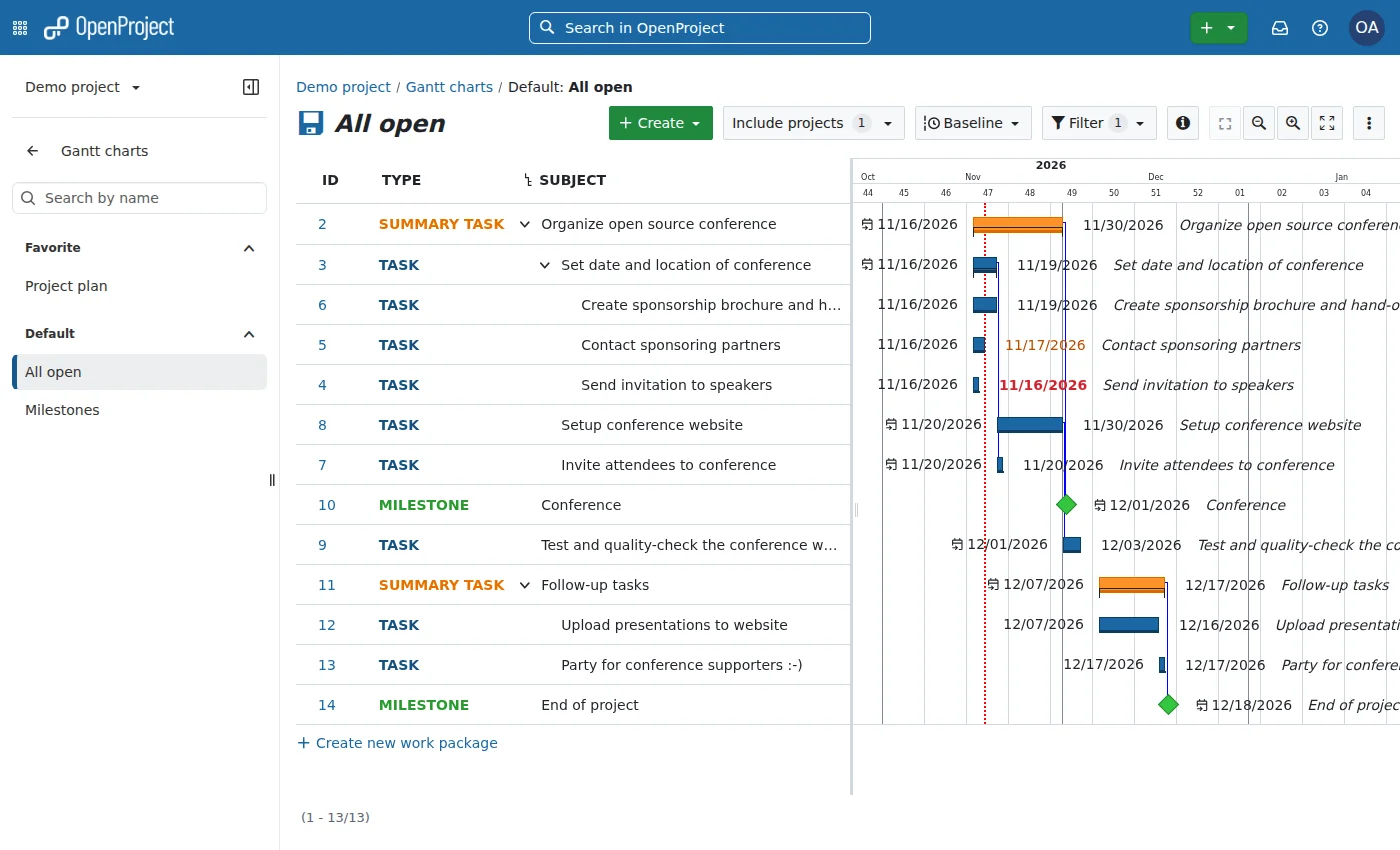
OpenProject starts with two sample projects, Demo project and Scrum project. Look around in them, then + Project to make your own. Under Project settings → Modules, turn on what you need (Gantt charts, boards, backlogs, wiki, time tracking) and leave off the rest; the menu stays short. Work packages → + Create adds a task; the Gantt view of the same list sets dates and dependencies by dragging.
Sign out (under your avatar) leads to exe.dev's log-out page; sign out there too, or OpenProject signs you straight back in.
Invite your team#
On your computer, let them through exe.dev:
ssh exe.dev share add my-openproject teammate@example.com
When they open https://my-openproject.exe.xyz/ and pass exe.dev's login,
OpenProject makes their account. After that first visit, add them to a
project under Project settings → Members. They aren't admins; make
someone one under Administration → Users. Don't use OpenProject's
Invite user for someone who hasn't visited yet: an invited account
isn't linked to exe.dev's sign-in, and they'd get a "Create an account …
Email has already been taken" page (see Something not working?). Until
you add them, they can look at, but not change, the two public sample
projects.
OpenProject takes people's names from their email: ana.lima@example.com
becomes Ana Lima, ana@example.com becomes "Ana example.com". To set a
name, yours included, add a line to ~/openproject/names.txt on the VM, such as
ana@example.com Ana Lima (append with echo '…' >> names.txt, or run
docker compose restart exe-ldap after editing it); it applies the next
time they sign in.
To take someone's access away, ssh exe.dev share remove my-openproject teammate@example.com, and lock their account under Administration →
Users if you like.
Let agents work on it#
Agents use API v3 as the
OpenProject user Agent, an administrator, with an API token that
Shelley keeps in ~/openproject/.env. Their work shows up under that
name. For narrower access, take away Agent's admin rights under
Administration → Users and add it to just the projects it may touch.
On the VM#
Shelley, Claude Code and Codex on this VM can call the API through
~/openproject/op-api, which adds the token and the headers OpenProject
wants. Try asking Shelley:
In OpenProject's Demo project, file a task "Login page is slow", comment with what you'd check first, then mark it as a duplicate of #7 and close it.
Or by hand:
cd ~/openproject
./op-api GET /projects | jq -r '._embedded.elements[] | "\(.identifier)  \(.name)"'
./op-api POST /projects/demo-project/work_packages '{"subject":"Hello from the API"}' | jq '{id, subject}'
From another VM or your laptop#
Through exe.dev's proxy, an agent sends two tokens: an exe.dev VM token in
X-Exedev-Authorization, which gets it past exe.dev's login
(HTTPS tokens for VMs), and the OpenProject
API token, as the password of the user apikey. Make the first on your
computer:
ssh exe.dev ssh-key generate-api-key --vm=my-openproject --label=openproject-agents --exp=90d
then, wherever the agent runs (paste your two tokens; the second is
OPENPROJECT_API_TOKEN in ~/openproject/.env on the VM):
export EXE_TOKEN=exe1.paste-yours-here OP_TOKEN=opapi-paste-yours-here
curl -s -H "X-Exedev-Authorization: Bearer $EXE_TOKEN" -u "apikey:$OP_TOKEN" \
  https://my-openproject.exe.xyz/api/v3/projects | jq -r '._embedded.elements[].name'
Expect your project names. Tell the agent the base URL, both headers and that the API is OpenProject's API v3 (HAL+JSON); it knows the rest.
The nuts and bolts#
Happy with what Shelley set up? Stop here. Below are the steps it followed, and maintenance for later.
Set up by hand
Create the VM#
On your computer (pick another name if my-openproject is taken):
ssh exe.dev new --name=my-openproject
ssh my-openproject.exe.xyz
Everything else runs on the VM.
Start OpenProject#
Docker on exe.dev VMs starts on demand; enable it so OpenProject comes back after a reboot. Then make the data folders and the secrets file. You, the VM's owner, will be OpenProject's admin, so the file holds your exe.dev email (from the VM's reflection integration), next to the Rails secret key, which encrypts parts of the database.
sudo systemctl enable --now docker.service
mkdir -p ~/openproject/{pgdata,assets,backups}
cd ~/openproject
owner=$(curl -fsS https://reflection.int.exe.xyz/email | jq -r '.email // empty' | tr A-Z a-z)
echo "OpenProject admin: ${owner:?no owner email; set owner=you@example.com and rerun}"
(umask 077; cat > .env <<EOF
OPENPROJECT_HOST__NAME=$(hostname).exe.xyz
SECRET_KEY_BASE=$(openssl rand -hex 64)
OWNER_EMAIL=$owner
EOF
)
ls -l .env
Expect the email you sign in to exe.dev with, then -rw-------. If the
reflection integration is missing, set owner= to that email yourself
and run the lines from (umask again. Back up this file: without
SECRET_KEY_BASE, a database backup comes back with its encrypted parts
unreadable.
OpenProject signs people in from a request header, X-ExeDev-Email,
which exe.dev's proxy sets for whoever it let in. That sign-in looks
every person up in an LDAP directory, so next to OpenProject runs
exe-ldap.py, a small
read-only directory (Python standard library, under 200 lines) that
answers for any email and refuses every password. names.txt sets
people's names (see Invite your team):
curl -fsSL -o exe-ldap.py https://exe-staging.dev/deploy/openproject/exe-ldap.py
touch names.txt
The official all-in-one image runs OpenProject, PostgreSQL and the rest
in one container. exe.dev's proxy terminates HTTPS and forwards to port
8000, so OpenProject runs in HTTPS mode with the VM's name as its host,
listens on 127.0.0.1 only, and sends people to exe.dev's log-out page when
they sign out. The default admin account is created locked, and the
OPENPROJECT_SEED_LDAP_EXE_* settings point OpenProject at exe-ldap,
which publishes no port:
cat > compose.yaml <<'EOF'
name: openproject
services:
  openproject:
    image: openproject/openproject:17
    restart: unless-stopped
    ports: ["127.0.0.1:8000:80"]
    environment:
      OPENPROJECT_HOST__NAME: ${OPENPROJECT_HOST__NAME}
      OPENPROJECT_HTTPS: "true"
      OPENPROJECT_DEFAULT__LANGUAGE: en
      SECRET_KEY_BASE: ${SECRET_KEY_BASE}
      OPENPROJECT_SEED_ADMIN_USER_LOCKED: "true"
      OPENPROJECT_AUTH__SOURCE__SSO_HEADER: X-ExeDev-Email
      OPENPROJECT_AUTH__SOURCE__SSO_OPTIONAL: "true"
      OPENPROJECT_AUTH__SOURCE__SSO_LOGOUT__URL: https://${OPENPROJECT_HOST__NAME}/__exe.dev/logout
      OPENPROJECT_SEED_LDAP_EXE_HOST: exe-ldap
      OPENPROJECT_SEED_LDAP_EXE_PORT: "3890"
      OPENPROJECT_SEED_LDAP_EXE_SECURITY: plain_ldap
      OPENPROJECT_SEED_LDAP_EXE_BASEDN: ou=people,dc=exe,dc=dev
      OPENPROJECT_SEED_LDAP_EXE_SYNC__USERS: "true"
      OPENPROJECT_SEED_LDAP_EXE_LOGIN__MAPPING: mail
      OPENPROJECT_SEED_LDAP_EXE_FIRSTNAME__MAPPING: givenName
      OPENPROJECT_SEED_LDAP_EXE_LASTNAME__MAPPING: sn
      OPENPROJECT_SEED_LDAP_EXE_MAIL__MAPPING: mail
    volumes:
      - ./pgdata:/var/openproject/pgdata
      - ./assets:/var/openproject/assets
    depends_on: [exe-ldap]
  exe-ldap:
    image: python:3.13-alpine
    restart: unless-stopped
    user: "65534:65534"
    command: ["python", "-u", "/app/exe-ldap.py"]
    volumes:
      - ./exe-ldap.py:/app/exe-ldap.py:ro
      - ./names.txt:/data/names.txt:ro
EOF
docker compose up -d --quiet-pull
The first start creates the database and loads the sample projects, which takes about four minutes. Wait for the health check (it needs the headers exe.dev's proxy would send):
. ./.env
until curl -sf -o /dev/null -H "Host: $OPENPROJECT_HOST__NAME" -H "X-Forwarded-Proto: https" \
  http://localhost:8000/health_checks/default; do sleep 10; done; echo ready
Expect ready.
Make yourself admin and give agents a token#
Create your account as an administrator, linked to exe-ldap, and an
Agent administrator with an API token, which goes into the secrets
file. Rails takes about a minute to load:
cd ~/openproject && . ./.env
token=$(docker compose exec -T openproject bundle exec rails runner '
  exe = LdapAuthSource.find_by!(name: "exe")
  owner = User.find_by(login: ARGV[0]) || User.new(login: ARGV[0], mail: ARGV[0], firstname: "Owner", lastname: "(exe.dev)")
  owner.update!(admin: true, status: :active, ldap_auth_source: exe)
  agent = User.find_by(login: "agent") || User.new(login: "agent", mail: "agent@" + ARGV[1], firstname: "Agent", lastname: "(API)")
  agent.update!(admin: true, status: :active)
  puts "TOKEN=" + Token::API.create!(user: agent, token_name: "agents").plain_value
' "$OWNER_EMAIL" "$OPENPROJECT_HOST__NAME" | sed -n 's/^TOKEN=//p')
[ -n "$token" ] && echo "OPENPROJECT_API_TOKEN=$token" >> .env && echo saved
Check that OpenProject takes your email from the header, as it will from exe.dev's proxy:
curl -s -o /dev/null -w '%{redirect_url}\n' -H "Host: $OPENPROJECT_HOST__NAME" \
  -H "X-Forwarded-Proto: https" -H "X-ExeDev-Email: $OWNER_EMAIL" http://localhost:8000/
Expect a URL ending in /two_factor_authentication/request, OpenProject's
next sign-in step (it lets you through without a second factor). One
ending in /sso means the lookup failed; see Something not working?
below.
Then a small helper, so agents on the VM don't have to remember the headers:
cat > op-api <<'EOF'
#!/bin/sh
# OpenProject API v3 from this VM: op-api METHOD PATH [JSON]
#   op-api GET /projects
#   op-api POST /projects/demo-project/work_packages '{"subject":"Hi"}'
set -eu
. "$HOME/openproject/.env"
method=$1 path=$2
curl -sSg --fail-with-body -X "$method" -u "apikey:$OPENPROJECT_API_TOKEN" \
  -H "Host: $OPENPROJECT_HOST__NAME" -H "X-Forwarded-Proto: https" \
  -H "Content-Type: application/json" ${3:+--data "$3"} \
  "http://localhost:8000/api/v3$path"
EOF
chmod +x op-api
Check it the way an agent would: create a work package, comment, close it, and delete it again:
id=$(./op-api POST /projects/demo-project/work_packages '{"subject":"Setup check"}' | jq .id)
./op-api POST /work_packages/$id/activities '{"comment":{"raw":"Commented over API v3."}}' >/dev/null
closed=$(./op-api GET /statuses | jq -r '._embedded.elements[] | select(.name=="Closed") | ._links.self.href')
lock=$(./op-api GET /work_packages/$id | jq .lockVersion)
./op-api PATCH /work_packages/$id "{\"lockVersion\":$lock,\"_links\":{\"status\":{\"href\":\"$closed\"}}}" \
  | jq -r '"#\(.id) \(.subject): \(._links.status.title)"'
./op-api GET /work_packages/$id/activities | jq -r '._embedded.elements[].comment.raw | select(. != "")'
./op-api DELETE /work_packages/$id && echo deleted
Expect #<n> Setup check: Closed, the comment, and deleted.
Back up nightly#
This script dumps the database with pg_dump inside the container (as
OpenProject's backup guide does), and adds the attachments, the secrets
file and names.txt. It keeps the 14 newest:
cat > backup.sh <<'EOF'
#!/bin/bash
# Back up OpenProject to ~/openproject/backups/openproject-<time>.tar.gz:
# the database (pg_dump), attachments, .env and names.txt. Keeps the 14 newest.
set -euo pipefail
umask 077
cd "$(dirname "$0")"
work=$(mktemp -d)
trap 'rm -rf "$work"' EXIT
docker compose exec -T openproject su - postgres -c 'pg_dump -d openproject -x -O' > "$work/openproject.sql"
tail -n 5 "$work/openproject.sql" | grep -q 'PostgreSQL database dump complete'
tar -C assets -cf "$work/assets.tar" .
cp .env "$work/env"
cp names.txt "$work/names.txt"
mkdir -p backups
out="backups/openproject-$(date -u +%Y%m%d-%H%M%S).tar.gz"
tar -C "$work" -czf "$out.part" .
mv "$out.part" "$out"
ls -1t backups/openproject-*.tar.gz | tail -n +15 | xargs -r rm --
echo "$out"
EOF
chmod +x backup.sh
Run it nightly:
sudo tee /etc/systemd/system/openproject-backup.service >/dev/null <<'EOF'
[Unit]
Description=Back up OpenProject
After=docker.service

[Service]
Type=oneshot
User=exedev
ExecStart=/home/exedev/openproject/backup.sh
EOF
sudo tee /etc/systemd/system/openproject-backup.timer >/dev/null <<'EOF'
[Unit]
Description=Back up OpenProject nightly

[Timer]
OnCalendar=*-*-* 03:30:00 UTC
RandomizedDelaySec=15m
Persistent=true

[Install]
WantedBy=timers.target
EOF
sudo systemctl daemon-reload
sudo systemctl enable --now openproject-backup.timer
Make the first one now and look inside:
backup=$(./backup.sh) && tar -tzvf "$backup"
systemctl list-timers openproject-backup.timer --no-pager
Expect openproject.sql, assets.tar, env and names.txt in the
archive, and the timer's next run.
Back up and restore
On the VM, ~/openproject/backup.sh makes a backup now and prints its
path. Copy backups off the VM now and then; on your computer:
scp 'my-openproject.exe.xyz:openproject/backups/openproject-*.tar.gz' .
They hold everything in OpenProject and the secrets file, so keep them private.
Restore#
On the VM, with OpenProject running, pick an archive. The restore stops
the web and background processes, replaces the database and attachments,
takes the secrets and names from the backup (keeping this VM's host
name), and restarts. The current attachments are kept in assets.before-restore;
run ./backup.sh first if you may want the current state back.
cd ~/openproject
backup=backups/openproject-YYYYMMDD-HHMMSS.tar.gz
rm -rf /tmp/op-restore && mkdir -m 700 /tmp/op-restore
tar -xzf "$backup" -C /tmp/op-restore
docker compose exec -T openproject sh -c 'printf "[supervisorctl]\nserverurl=unix:///var/run/supervisor.sock\n" > /tmp/sc.ini && supervisorctl -c /tmp/sc.ini stop web worker hocuspocus'
docker compose exec -T openproject su - postgres -c "psql -q -c 'DROP DATABASE openproject WITH (FORCE)' -c 'CREATE DATABASE openproject OWNER openproject'"
docker compose exec -T -e PGPASSWORD=openproject openproject \
  psql -q -v ON_ERROR_STOP=1 -h 127.0.0.1 -U openproject -d openproject < /tmp/op-restore/openproject.sql >/dev/null
sudo rm -rf assets.before-restore && sudo mv assets assets.before-restore && mkdir assets
tar -xf /tmp/op-restore/assets.tar -C assets
{ grep '^OPENPROJECT_HOST__NAME=' .env; grep -v '^OPENPROJECT_HOST__NAME=' /tmp/op-restore/env; } > .env.new
chmod 600 .env.new && mv .env.new .env
cp /tmp/op-restore/names.txt names.txt
rm -rf /tmp/op-restore
docker compose up -d --force-recreate
Wait for ready with the health check from the setup, then open the
site: your projects and accounts are as they were at the backup. On a new
VM, do Set up by hand up to the health check first, copy the archive over
with scp, and restore the same way. A backup restores into the same
OpenProject version or a newer one, not an older one.
Update
The 17 tag follows OpenProject 17's minor and patch releases. On the VM,
back up, pull (OpenProject and the Python image exe-ldap runs on), and
restart; migrations run on start:
cd ~/openproject
./backup.sh && docker compose pull --quiet && docker compose up -d
docker compose logs --tail=20 openproject
Then wait for ready with the health check from the setup.
Administration → Information shows the version.
For the next major version, read the
upgrade notes
first: OpenProject only upgrades one major version at a time, and a new
major can come with a newer PostgreSQL, whose data the all-in-one image
won't convert by itself (see their PostgreSQL migration guide). Then
change :17 in compose.yaml and update the same way. After an update,
check that exe.dev sign-in still works for you before you leave it.
Something not working?
On the VM, the containers and their logs:
cd ~/openproject
docker compose ps
docker compose logs --tail=50 openproject
docker compose logs --tail=20 exe-ldap
"Single Sign-On (SSO) for user … failed". OpenProject couldn't look
the email up in exe-ldap. Check that exe-ldap is Up in
docker compose ps and its log says listening; docker compose up -d
starts it. The same message comes for an email that already belongs to an
OpenProject account not linked to exe-ldap (made by hand under
Administration → Users): delete or rename that account.
"Create an account … Email has already been taken". The person was invited by email (Invite user) before their first visit, so their account isn't linked to exe-ldap. Link it, on the VM, and they're signed in on their next visit:
cd ~/openproject
docker compose exec -T openproject bundle exec rails runner \
  'User.find_by!(login: ARGV[0].downcase).update!(ldap_auth_source: LdapAuthSource.find_by!(name: "exe")); puts "ok"' teammate@example.com
Signed in, but not as an admin. The email you sign in to exe.dev with
isn't OWNER_EMAIL in .env. Any admin can change that under
Administration → Users; or, on the VM, after visiting once:
cd ~/openproject
docker compose exec -T openproject bundle exec rails runner \
  'User.find_by!(login: ARGV[0].downcase).update!(admin: true); puts "ok"' you@example.com
Sign out signs you straight back in. Sign out of exe.dev too, on the page OpenProject sends you to. That page belongs to exe.dev, not OpenProject.
Someone's name is wrong. Names come from exe-ldap on each sign-in, so
editing them in OpenProject doesn't stick; add a line such as
ana@example.com Ana Lima to names.txt, and it applies the next time
they sign in.
503 Service Unavailable for a few minutes after a start. OpenProject
runs migrations before it serves, so it takes about three minutes after
a reboot or update; on a first start it also creates the database. Watch
the log until Puma says Listening on http://0.0.0.0:8080.
400 Bad Request or "Blocked hosts". The address doesn't match
OPENPROJECT_HOST__NAME, for example after renaming the VM or adding a
custom domain. Fix it in .env, then
docker compose up -d.
curl http://localhost:8000/... gets 400 or a redirect to https://.
OpenProject runs in HTTPS mode for the VM's host name and expects the
proxy's headers. Use
op-api, or send Host and X-Forwarded-Proto: https as it does.
An agent gets a 307 redirect to exe.dev's login, or a plain-text
401 "invalid or missing authentication". exe.dev's proxy didn't get
or didn't accept the VM token: check X-Exedev-Authorization: Bearer ...
and the token's expiry. A JSON 401 (Unauthenticated) comes from OpenProject:
check the API token and that it's sent as the password of apikey.
Down after a reboot. Run sudo systemctl enable --now docker.service.
Emails never arrive. OpenProject has no mail server here; see the FAQ below.
Frequently asked questions#
Is OpenProject free?
The Community edition is free and open source (GPL-3.0), with no user limit. OpenProject GmbH sells Enterprise plans (Basic, Professional, Premium, Corporate) that unlock add-ons in the same code with a license key, plus support. On exe.dev you pay only for the VM.
What's paywalled in the Community edition?
As of 17.9: single sign-on with OpenID Connect or SAML, the built-in MCP server, internal comments and sharing work packages with outside users need Professional; the team planner, baseline comparisons, custom actions, placeholder users, hierarchy custom fields, custom theme and logo, and multiple active sprints need Basic; portfolio management, LDAP group sync and resource management need Premium. Work packages, Gantt charts, all board types (since 17.3), backlogs and sprints, date alerts (since 17.9), time and cost tracking, wiki, meetings, the API and webhooks are free. The Enterprise guide has the current table.
How does the exe.dev sign-in work without Enterprise?
OpenProject Community has a free header-based sign-in (OPENPROJECT_AUTH__SOURCE__SSO), set here to read exe.dev's X-ExeDev-Email. It only accepts people it can look up in an LDAP directory, so the setup runs a tiny one, exe-ldap.py, that answers for any email with a name made from it, and refuses every password. Both are documented OpenProject settings, no patches. OpenID Connect and SAML, the usual ways, are Enterprise add-ons.
Can someone fake the exe.dev login header?
Not from outside. exe.dev's proxy removes any X-ExeDev-* headers a browser sends and adds its own for the signed-in user. OpenProject listens only on 127.0.0.1, so only the proxy and programs on the VM itself can reach it; anyone with SSH or root access to the VM can already do anything there. exe-ldap can't be used to sign in with a password, and OpenProject's default admin account is locked.
Does OpenProject have an MCP server?
Yes, built in since 17.2 and able to create and update work packages since 17.8, but it's an Enterprise add-on (Professional plan and up). Community-maintained MCP servers for the Community edition exist, such as openproject-ce-mcp; this page wasn't tested with them. Any agent can use API v3 with the op-api helper or curl, as shown above.
How much memory does it need?
About 2 to 2.7 GB once started and in use, measured on fresh installs (two web workers, the background worker, PostgreSQL, memcached), plus about 15 MB for exe-ldap: fine on a default exe.dev VM, alongside a few smaller things. The image takes 3.3 GB of disk. Setting OPENPROJECT_WEB_WORKERS: 1 in compose.yaml runs one web worker instead of two and uses less.
Can I move from Jira?
OpenProject has a Jira Migrator under Administration → Import. In 17.9 it's a beta, for Jira Data Center 10 and 11 only (not Jira Cloud), and OpenProject says to use it on test setups for now. It isn't an Enterprise add-on. Back up before an import.
Can OpenProject send email?
Only with an SMTP server of yours: exe.dev's email gateway is an HTTP API, not SMTP. Without one, notifications stay in OpenProject's in-app inbox, which is fine since nobody needs a password email. To add SMTP, put the OPENPROJECT_SMTP__* settings from the configuration guide in compose.yaml, with OPENPROJECT_EMAIL__DELIVERY__METHOD: smtp.
Updated Nov 17, 2026 · tested end to end Nov 17, 2026 · Markdown · manifest.json · Something wrong? Tell us